

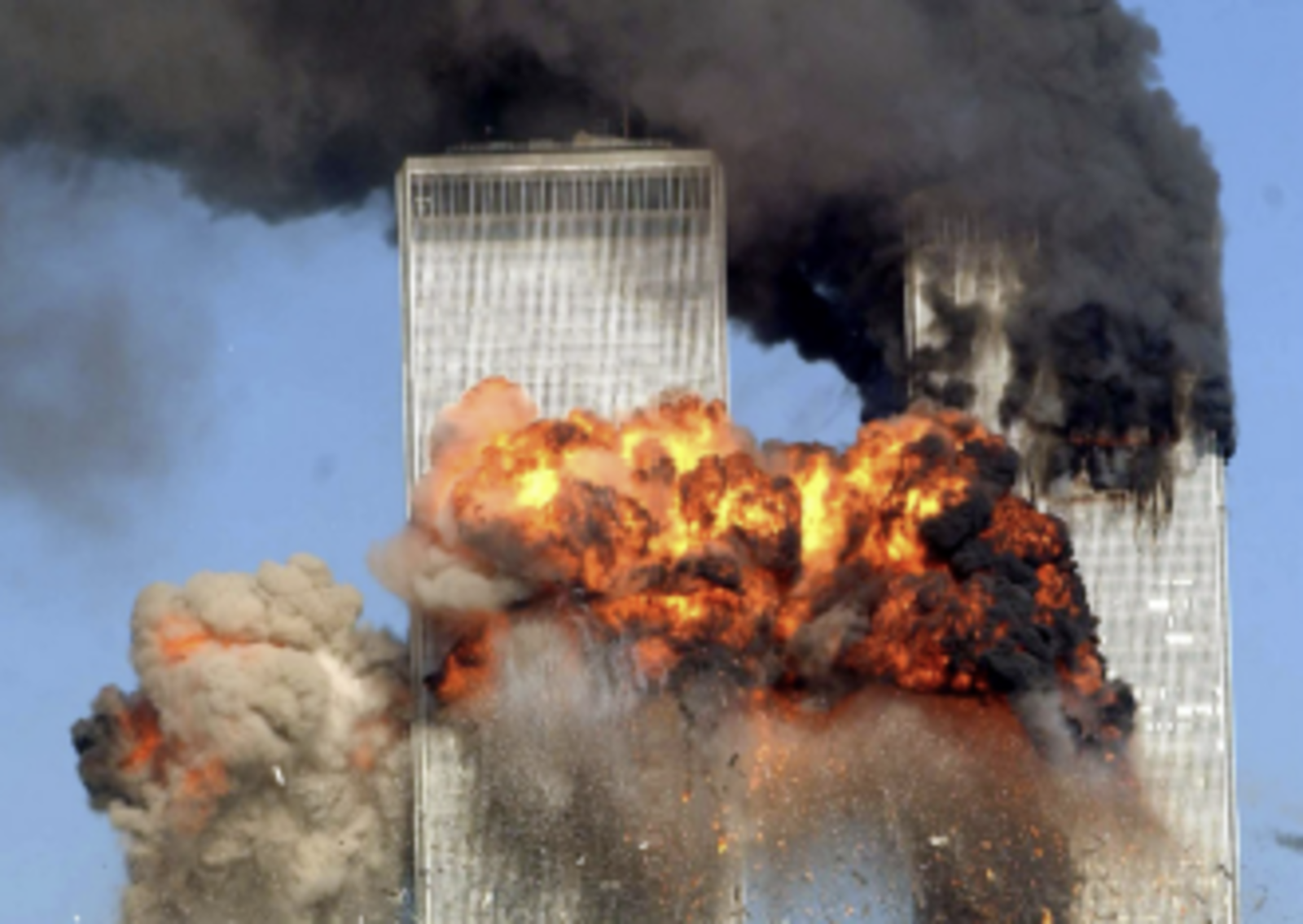
Dr. Davis at Columbia
The calm wind of the September morning wafted through the open windows as Dr. Davis took a seat for his first Roman Social History class of the year. He had just begun his PhD program at Columbia University.
“The building I was in at Columbia is right on Broadway, near a fire station,” he described. A few minutes into class, a firetruck’s siren interrupted the professor, but no one was fazed. Then another fire engine flew by. “And then it was just a constant train of blazing sirens. You couldn’t hear a word the professor was saying.”
The lecture hall was unaware of the crisis unfolding approximately eight miles away. When the bell rang, someone told Dr. Davis: “A plane flew into the World Trade Center… we might be under attack!”
He rushed home and turned on the
news. “I watched the other planes hit. It was surreal… not knowing what was going on, what other planes were in the air.”
The scale of the attacks weighed on people everywhere. “Nobody knew if there was going to be more than just the planes. Were there going to be truck bombs like the first attempt in the World Trade Center?”
On February 26, 1993, a truckloaded with 1500 pounds of explosives detonated beneath the North Tower, killing six people and injuring more than a thousand.
Walking down the middle of Broadway later that day, Dr. Davis did not see a car on the road. The only traffic came from the destroyed towers: people staggering in business suits caked with dust and debris. “It really had a post-apocalyptic feel to it.”
He approached the emergency personnel who lined the streets. “Of course, when I got there, they were saying ‘get lost,’ but they did also ask for blankets and water.” With some friends, he bought as much as they could carry from an open store.
Dr. Davis remains an avid supporter of the “Never Forget” notion: “It is important to ensure that future generations understand the true scale and impact of the tragedy.”
Mr. Peck in Boston
It was just a regular September day for Mr. Peck ’77 at Merrill Lynch. While on the phone with a trader in a building across the street from the World Trade Center, he heard “a bunch of people yell that they had heard that a small plane had crashed into the World Trade Center.” It was no reason to suspend their workday, so he carried on for another 30 minutes. Then he watched the second plane hit the other tower on the television monitors in his office. Seeing both buildings engulfed in flames while police and fire trucks rushed to help is a scene he says he will “never forget.”
Having moved to Boston from New York only a few months earlier, Mr. Peck had many business associates and friends in the city. Many of the brokers he used at Merrill Lynch worked for Cantor Fitzgerald, which occupied six floors at the top of the South Tower and lost 658 employees, two-thirds of its workforce, that day. One friend lost his life after being forced to jump into the Hudson River by debris following the collapse. He lost “many other friends during this period of time,” and some colleagues lost relatives.
Mr. Peck recalls that “there were many firefighters and police officers on the scene, trying to get people out and down the stairways. Their bravery was unrecognized in many cases.” “Those who went to rescue the people in the buildings lost their lives fulfilling their duties as firefighters and policemen. They were true heroes,” he said.
Given the 1993 attempt, he said, “For people working in the city and particularly in large towers, I don’t think life will ever be the same.” Twenty-five years later, Mr. Peck wants people to remember those lost, particularly the firefighters and police officers who died trying to save others.
Mr. Schneider in Washington D.C.
Passing the Washington Monument in D.C., Mr. Schneider was chaperoning his students from Rye Country Day School in New York on their last day before departing. The group was still shaken by the news of a plane striking the World Trade Center, which they had learned about as they were leaving the hotel. Yet no one had made the connection that America was under attack. “Everybody sort of had this assumption that it was just a small plane,” Mr. Schneider recalled, “like somebody had made a mistake.”
Just as they passed the Washington Monument, a deafening explosion rippled through them, and in the distance, Mr. Schneider watched a mushroom cloud form in the direction of the Pentagon. One of the boys handed his cell phone to Mr. Schneider. On the other end of the line, the boy’s father, hysterical, screamed, “We’re under attack! Get my kid out of there!”
Mr. Schneider gathered the frantic children and took them back to the hotel. Since many of the students’ parents lived in Manhattan or even worked in the towers, “we adults were sort of watching over the kids, trying to help them figure out if their parents were okay.” All the students’ parents and the students themselves were safe, but they were forced to stay for another night. With flights grounded, Mr. Schneider drove back to New York the next day. “We saw the smoke and dust from the collapsed towers, because we were coming from D.C., and we passed the south side of the city.”
The sense of uncertainty persisted after September 11th. “It traumatized all of us, you know, that feeling of not feeling safe… The feeling of vigilance: like something else was gonna happen next.” The intense apprehension of another attack deepened his perspective on the privileges of living in America. “It did make me feel aware that there are some people in some countries who live around terrorism, and that constant vigilance.”
In 2007, Mr. Schneider moved to Berwick Academy in Maine to serve as Head of School, where the tradition to commemorate 9/11 was a circle remembrance. The entire school joined hands in concentric circles around him, remaining completely silent as the bell tower rang eleven times. “As that bell rings and you’re in that moment of silence, you feel like the whole school is waiting for you to move. You can feel your heart thumping. It was a really powerful thing.”
When Mr.Schneider joined our campus in the fall of 2018, he was struck by the dedication to honoring the sacrifices of emergency services personnel and the military. “I think here you get a much clearer sense of service and how noble that calling is. To me, that through line is very powerful at this school.”
Mr. Sullivan and Mr. Davis at BH
Mr. George Sullivan ‘07 and Mr. Davis ‘07 joined Belmont Hill as Form I students in the fall of 2001. While they were still getting acquainted with wearing a coat and tie and the unfamiliar boys in their classes, the teachers slowly began to learn the news from New York.
“It was the first and only time I remember the PA system ever be-
ing used,” Mr. Davis ‘07 recalled.
They and their classmates were ushered into the Chapel, still disoriented. The faculty were in MacPherson deliberating about what to do, so the school president was on stage, attempting to settle the room as the news spread from row to row. “There were students with parents working or traveling in New York, and they were desperate to find out if they were safe.”
The faculty ultimately decided it was best to keep the boys at School. Before they were dismissed, Mr. Sullivan ‘07 and his friends somehow found miniature American flags and began distributing them to their classmates. “On the bus ride home, we were leaning out the windows, waving these flags, and cars were honking as they drove past. That was when the Belmont Hill
brotherhood first felt so great for me.”
In the famous words of former Upper School Head Mr. Goodband, “When times are tough, Belmont Hill is at its best.” Whether it was students who had only met a few weeks prior uniting to show their patriotism through bus windows, or the constant support for each other during and after 9/11, Belmont Hill truly knit together as a community and brotherhood.
The Aftermath
In the weeks following 9/11/2001, many felt reverberating fear and trauma. Planes were entirely grounded for multiple days, making one acutely aware of their absence. As Mr. Richards was rowing on the Charles in late September, he noticed the first
plane he had seen since the attacks.
“From my perspective on the water, I could see it departing from Logan Airport, and flying in the direction of Back Bay,” Mr. Richards recounted. “And because of where I was positioned, it looked to me like the plane was heading straightfor the John Hancock Tower. At that moment, I thought to myself, probably from the recent memory of 9/11, I’m about to witness a world-altering event.”
The plane flew past the tower, most likely miles away, yet the constant, innate fear that 9/11 had imprinted on Americans made everyday moments like these seem ominous.
Back in New York, a few days after the events, Dr. Davis still struggled to contact his family members through downed cell service. His folks lived in Boston, and he believed that the gas towers in Dorchester could have been the next target. “People were really concerned about the government buildings, too. My folks live right near there. And my father worked not far
from there in a government building.”
Over the span of months, as more information about the attacks and the attackers emerged, feelings of uncertainty persisted. At Rye Country Day, Mr. Schneider remembered: “You started to learn about all the stories of how the attackers trained to fly the planes, and how long and elaborate the planning had been. That all was sort of unnerving.”
People felt this unease nationwide, including within the government. “It was true that 9/11 led to a period of government expansion,” Mr. Schneider related. “Everything related to security and the government’s power to investigate people increased, which I’m not sure if that calmed or sparked more nervousness.”
As the years pass, the attacks have become history for the students of Belmont Hill. “I think about Pearl Harbor. I’ve seen movies, but it feels like I have no connection or emotional response,” Mr. Schneider reflected. “It makes me think, what will be that moment for the current students? Or will there ever be a moment?”


