

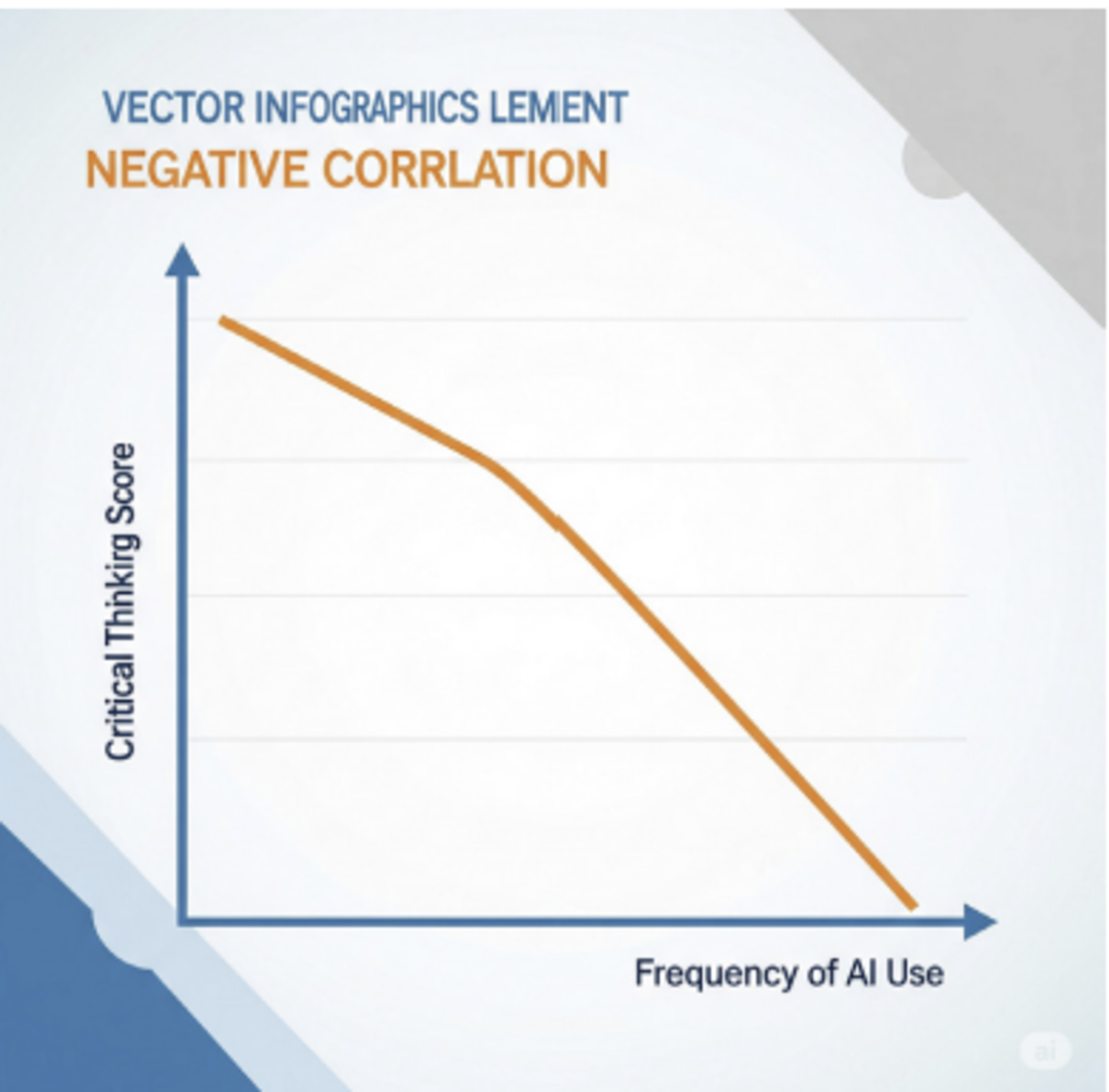
In Chapel on September 17th, Mr. Richards discussed “lifting styrofoam weights,” and that same week, both Mr. Sullivan and Dr. Davis discussed “cognitive offloading.” In an age when artificial intelligence is more prevalent than ever, especially in academic settings, using AI to substitute for a range of work is an increasingly accessible choice. Monotonous tasks, such as data entry, can be delegated to AI with minimal impact. However, AI can also substitute for more complex tasks, such as exploring alternative solution pathways for a math problem, developing the thesis of a history essay, or applying critical thinking to analyze an English passage. While in all of these situations, AI can get you to a final destination that may or may not meet a specific deadline or requirement, it bypasses the journey that develops critical thinking skills. Accordingly, while artificial intelligence can almost always get you to a correct answer, an over-reliance on the tool significantly limits one’s ability to succeed without it.
First, there is the hard data. MIT’s August 2026 study, AI Use in Teaching, Learning, and Research training, observed multiple groups of students, assessing students who used generative AI to write English essays and those who did not. The results were supported by scientific data, as the groups that used generative AI exhibited significantly lower neural conductivity and reduced brain activity while writing the essay. When you use AI to replace independent thinking, you are literally using your brain less. A 2025 Oregon State study showed that among heavy AI users, there was a 41% decline in critical thinking skills, a 66% decline in content retention, and a 21% decrease in the need to understand underlying concepts. Using AI to replicate your work caps your ability to retain what you submitted, limits your ability to think critically to find solutions, and creates a false sense of understanding for complex topics. There are countless studies that have recently been published or are underway, given AI’s youth. So far, there is no way to quantify the long-term negative effects of compounding AI use over years, decades, and a lifetime. If just a few years of AI use in high school, college, or the workforce already negatively impacts critical thinking skills, that effect, compounded over time, poses a serious threat to our future generations’ abilities.
Second, there are all the day-to-day examples of how AI usage negatively impacts your future. For our theoretical example, we will observe the actions of two students taking the same class. James and Michael are both taking an AP mathematics course – one infamous for its difficulty. Neither James nor Michael is specifically passionate about math and doesn’t have a significant interest in the class. From day one, the class is hard. The homework problems are intense, and the nature of the class is different from what they’re used to. Each problem takes time and serious, focused critical thinking to work through. Part of the overarching theme of the class is that you can’t just memorize formulas or pathways to solve problems – you have to try multiple pathways and experiment. Every day after school, James comes home and opens up the homework. He glances at each problem, and if he doesn’t immediately understand what to do, he inputs it into a generative AI model. James copies down what the AI says, reading through each step, writing it down, and thinking to himself, “I understand it now, I could do this if the problem came up again.” James then submits his work without thinking twice. Michael, on the other hand, opens the same homework assignment and gets stuck on multiple questions. Instead of using AI, he sits with each problem for a long time, exploring different pathways he worked on in class. It takes Michael longer to do the homework, and he gets a few questions wrong, but he genuinely understands what he did and worked his brain to arrive at these solutions. Then, they each submit the homework: James gets a perfect 10/10 and doesn’t think twice. Michael gets an 8.5/10 because he couldn’t arrive at the correct solution on a couple of problems. While it seems like using the AI was the smart choice, a test looms at the end of the week. On test day, James gets crushed, as when the problems are slightly different, he has no idea what to do. This is just like the homework for Michael, though, who exercises more critical thinking and does quite well. When they get their tests back, Michael gets an A, and James finds himself questioning if he should even take the class. Even though using AI was a much easier and more efficient choice early on, when knowledge and critical thinking skills actually mattered, it put James at a significant disadvantage.
Ultimately, artificial intelligence is an extraordinarily powerful tool, but its greatest danger may be how easily it can replace the very thinking that makes the tool useful in the first place. Lifting styrofoam weights is easier than lifting real ones, just as asking AI for an answer is easier than struggling to find one yourself. The problem is that the purpose of the exercise is not simply to move the weight or reach the answer; it is to develop the strength required to do it independently. Cognitive offloading works the same way. When we consistently allow AI to think, analyze, and solve problems for us, we may complete our work more efficiently, but we sacrifice opportunities to develop the skills that will matter when AI cannot do the work for us. James and Michael emphasize this: while James had the easier path at the start, using AI ultimately harmed him. Regardless of the ethical implications of using AI and of school policy, both of which are undoubtedly important, the negative impact of AI use should be a deterrent in and of itself.


