

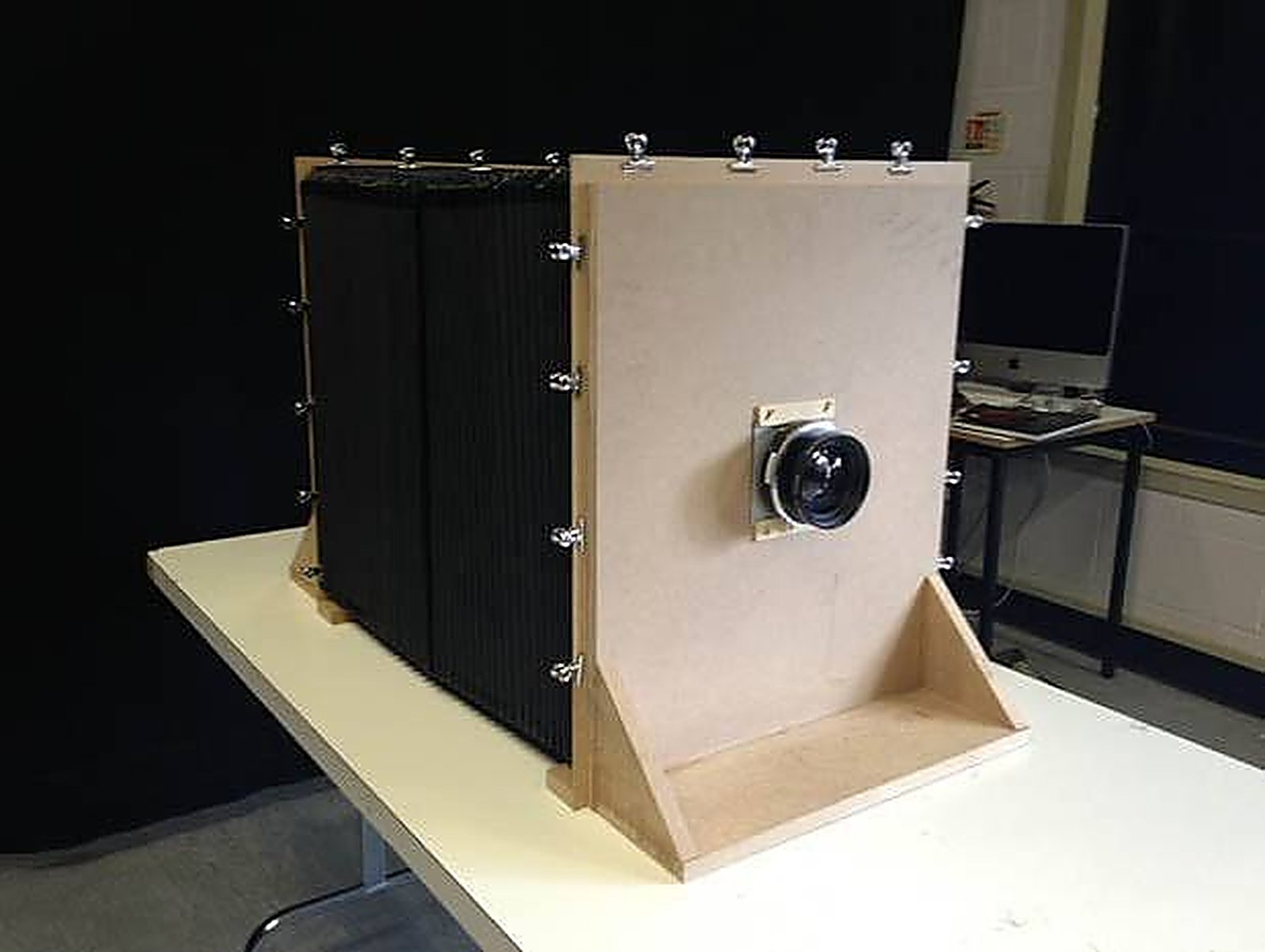
In Italian, “camera” translates to room. Recently, Mr. Duarte and Mr. Ziff have teamed up to create an ultra-large-format camera, which perfectly embodies this definition. Their creation is shaped like a box, measures 19 x 20 x 17 inches, and involves no electronics, yet is capable of creating incredibly sharp pictures. On the outside, the camera is a perfect rectangular prism except for one powerful lens protruding out from the front. Inside, there are very few components as well: the most important ones being the light-sensitive darkroom paper in the back, and the emptiness between the paper and the lens.
It is this vacant space in the camera that makes it so comparable to its Italian definition, and is necessary for the camera’s functionality. As light streams in through the lens when the camera is used, it must travel a precise distance before making its permanent mark on the darkroom paper to create a clear image. The exact distance is reliant on the lens that the camera uses. In an interview, Mr. Duarte summarized, “the height and width [of the camera] are driven by the size [of the paper], but the depth of the box is driven by the lens you put on it.” For Mr. Ziff and Mr. Duarte, determining how long the width should be was a difficult process. Due to the diverse nature of lenses, there is no standardized way of interpreting the required length between the lens and the light-sensitive paper, so they had to first determine what their “355mm lens” could mean. Eventually, after adjusting their original dimensions, they were able to determine the dimensions of the skeletal part of the camera and created the box. This was still only half of the battle, however; they still needed to secure an apparatus that could hold the darkroom paper in place. For this, Mr. Duarte contacted one of the only photographers in the US who had the knowledge to create it: Richard Ritter. After 8 months of waiting, the hand-made holder finally arrived, and the camera was assembled.
Throughout the process, Mr. Duarte stated that he brought the “photo side” of this project, while Mr. Ziff said that he brought the “making side”. Mr. Duarte had thorough knowledge of the required mechanisms in the camera, had the ability to develop the darkroom paper in the darkroom, and connected them with Richard Ritter. Meanwhile, Mr. Ziff knew how to operate the Makerspace machines, including the 3D printers and CNC mill. They were inspired by a similar project that they had in the previous years, which was an 11 x 14 inch camera, and Mr. Duarte also stated that he was inspired by photographer Chris McCaw who was known for his work involving super powerful lenses. Eventually, Mr. Ziff and Mr. Duarte want the camera to be used by students and teachers, serving as an “interactive piece” for the Belmont Hill community. Mr. Duarte wants to give as many students as possible the chance to engage in photography, while Mr. Ziff wants students to appreciate the long but rewarding engineering process.
The camera has only been used a few times, but Mr. Duarte and Mr. Ziff consider the prints to be very promising. One was of the Chapel, and they were proud of how sharp the resolution of the finer details were. In the future, they want to polish up the appearance of the camera, and make it more cost effective by changing the darkroom paper used.
This partnership resulted in the creation of a camera so rare that Mr. Duarte estimates that there are “less than five high schools in the country” with similarly ultra-large format cameras. They acknowledge the privilege they had as members of the Belmont Hill community, as it was thanks to the school that they were able to secure the proper tools and resources to bring this project to life.
Ultimately, the camera represents more than just an engineering accomplishment or a photographic tool. It is an example of how traditional techniques can still find a place in an increasingly digital world. While its construction required months of planning, specialized knowledge, and considerable patience, its eventual purpose extends beyond the photographs it produces. By making the camera accessible to students and teachers, Mr. Duarte and Mr. Ziff hope to create opportunities for others to experience both the artistic and technical sides of photography, ensuring that the project becomes a lasting part of the Belmont Hill community.


