

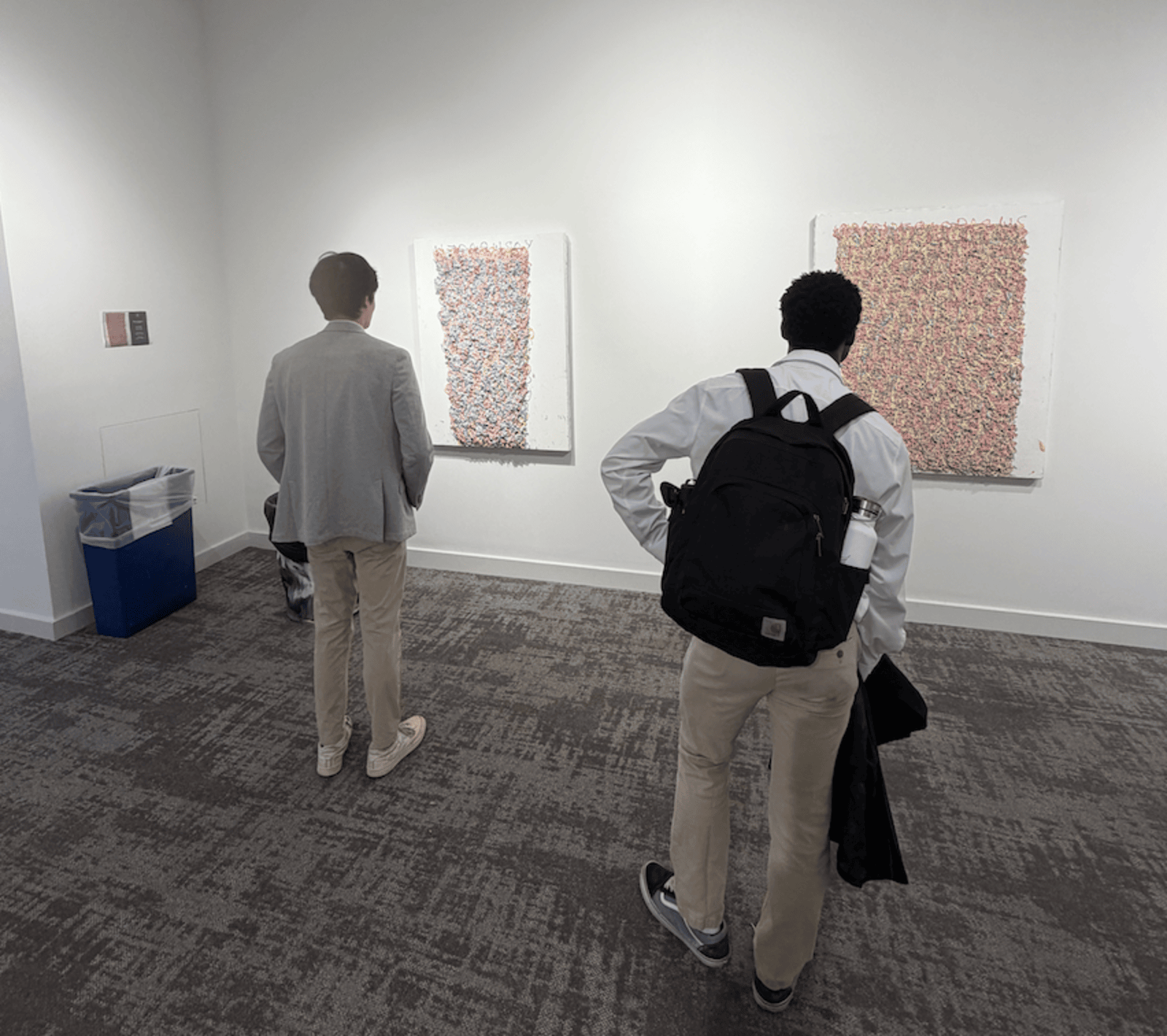
On April 22nd, 2026, a new artist and his works were set up in the Landau Gallery. Martin Mugar graduated from Belmont Hill in 1967, before attending Yale University from 1967 to 1971. After graduating with a Bachelor’s degree in art, he attended the Yale School of Art, earning a Master of Fine Arts. Following graduate school, Martin taught art at the college level at several different schools, before deciding to pursue his own art as a priority. Painting more physical, representational art in his early years, he transitioned to abstractionism as he grew older. In creating a new type of abstract art known as ‘Zombie Abstractionalism’, Mugar summarizes his reasoning for the movement: “Zombie Modernism is Modernism without the authoritative stance of self-consciousness.”
Finding fault and wanting to express himself in a way that had not existed before, Mugar completely founded his own style and would find great success in the artistic world. Believing many of the ideals that founded modernism and abstractionism are flawed, stating that religion and society warped modernism to create something that was not true to its origin. In the following years, Mugar moved far from any sort of representational art, deeming that any recognizable forms in any art would move away from what he wanted. Each day, his works grew more complex and subtle, creating canvases layered with paint that needed to fully dry before a new layer could be applied, with each work taking months to complete. Inspired by Buddhist culture and art, Mugar continued pursuing ‘Zombie Abstractionalism’, creating several works that embodied his ideology perfectly.
Looking at his works in our gallery, many students have been perplexed by the ideas they express. Students have stated that his work does seem to represent something for them, with one student pointing out what looks like letters or symbols of the Greek alphabet, believing the work to be an ironic representation of modern censorship, or a representation of the cluttered mess that social media and modern society have on the world. Upon first glance, a piece from Mugar looks very chaotic and colorful, sort of like an explosion of paint, but on further glances, one understands that it is actually the complete opposite. With each specific layer of paint, along with purposeful symbolism and shapes that remind a viewer of our own language, Mugar forces each viewer of his art into an intricate mental dilemma, compiling pleasing visual images with difficult mental concepts, creating masterpieces. Mugar’s work continues to move people, inspiring new ideas in people who would have otherwise never thought that way.


